
When Techno Leaves the Club
Electronic music has always been defined by its spaces—dark warehouses, industrial clubs, and vast festival stages designed to contain its intensity. But when it escapes those boundaries, it changes shape entirely.
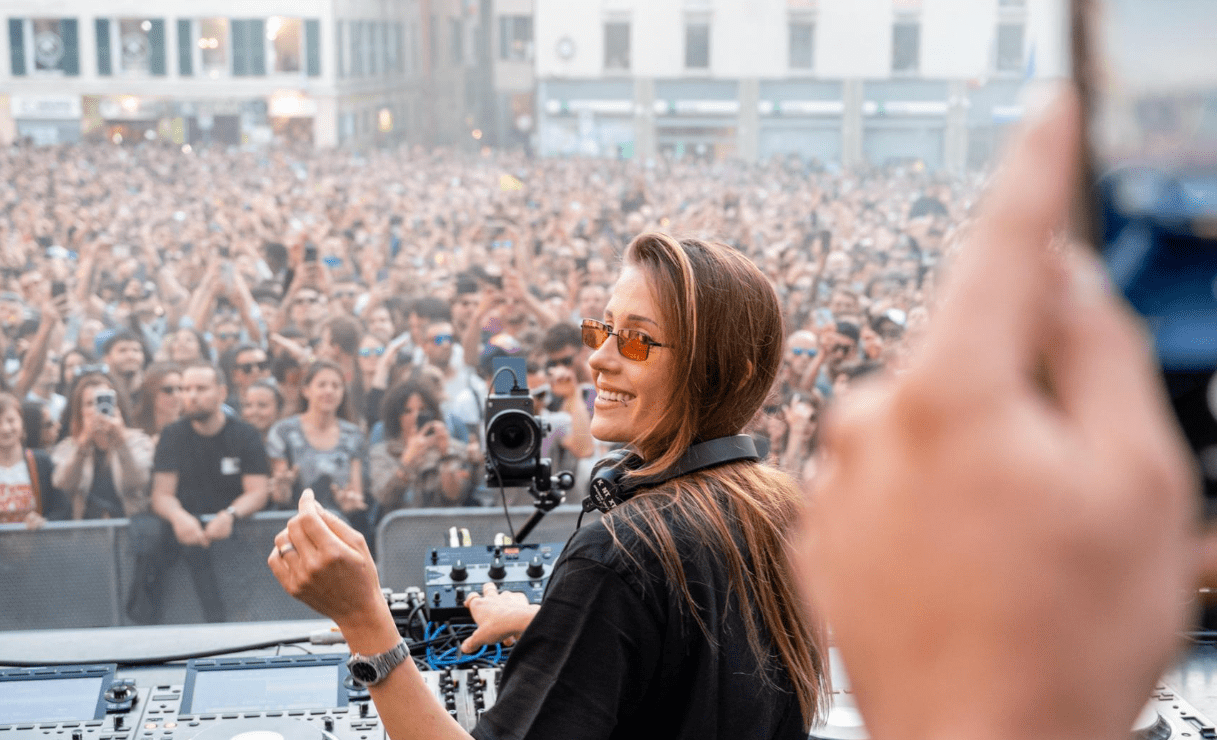
That transformation became reality in Genova, where Charlotte de Witte brought her uncompromising techno sound into the heart of the city’s historic Piazza Matteotti, turning a public square into a fully functioning open-air rave.
What unfolded was not a traditional performance. It was a temporary rewriting of urban space.
A Square Transformed Into a Rave Infrastructure
With support from city leadership, the event transformed one of Genova’s most recognizable public spaces into a large-scale electronic music environment. The setup was minimal in concept but maximal in impact: sound, architecture, and crowd energy merged into a single moving system.
By the time de Witte took control of the decks, the square had already filled with tens of thousands of people. Reports from the event place attendance at over 20,000, making it one of the largest open-air techno gatherings the city has hosted in recent years.
The sound design carried her signature identity—tight, driving, and deliberately unrelenting. But in this context, the music took on a different weight. It wasn’t just club energy projected outward; it was techno interacting with civic space.
KNTXT and the Expansion of Techno Formats
Behind Charlotte de Witte’s growing series of unconventional performances lies a clear artistic direction: expansion beyond traditional venue logic.
Through her label and event brand KNTXT, she has steadily built a framework for presenting techno as a flexible cultural format rather than a fixed nightlife product.
From city takeovers to large-scale immersive productions, her recent projects suggest a deliberate move away from exclusivity and toward accessibility—without diluting the intensity that defines her sound.
Genova fits directly into this evolution. It is part of a broader pattern where techno is no longer confined to club systems but is being tested in public, civic, and architectural environments.
The Crowd, the City, and the Unexpected Cultural Layer
While the scale of the performance was significant, an unexpected secondary narrative quickly emerged: the reaction of the city itself.
Footage from the event shows Genova’s Piazza Matteotti fully absorbed into the performance, with architecture acting as a natural amphitheater for sound and movement. The city did not merely host the event—it became part of it.
What elevated the moment further was the visible presence of local civic leadership. Genova mayor Silvia Salis was seen within the crowd, engaging with the atmosphere in a way that quickly circulated across social media platforms.
Clips of the moment spread rapidly, turning into a viral snapshot that blurred the line between institutional presence and cultural participation.
Virality and the New Language of Public Music Events
In today’s digital ecosystem, moments like this rarely remain local. Within hours, footage from Genova was circulating across TikTok, Instagram, and X, reframing the event as both a music moment and a cultural meme.
But beneath the virality lies a deeper shift in how electronic music interacts with public perception.
Techno, once associated primarily with underground subcultures, is increasingly becoming part of mainstream civic storytelling. City-backed events like Genova reflect a growing willingness from municipalities to engage with electronic music not as a subcultural risk, but as a cultural asset.
The Political Dimension of a Dancefloor
The presence of public officials at such an event adds another layer of interpretation. It signals a shift in how cities position themselves culturally—where electronic music becomes part of urban identity rather than something separate from it.
In this case, the mayor’s visible engagement was not just a viral moment. It became symbolic of a broader acceptance of techno as a legitimate form of public gathering.
This is where Charlotte de Witte’s performance extends beyond music. It becomes a case study in how sound can reshape the meaning of public space.
Charlotte de Witte and the Rewriting of Techno Geography
Few artists in contemporary techno have pushed the boundaries of performance context as consistently as de Witte. From underground clubs to global festival mainstages, and now into city squares, her trajectory reflects a widening definition of where techno can exist.
Her approach does not soften the genre for public consumption. Instead, it relocates it—placing its intensity into environments that were never originally designed for it.
Genova represents one of the clearest examples of this philosophy in action.
Closing Perspective: A City That Became the Set
What happened in Genova was not simply a concert, and not entirely a festival. It was a temporary reconfiguration of the city’s identity through sound.
For one night, Piazza Matteotti functioned as something else entirely—a shared space where architecture, politics, and electronic music converged without hierarchy.
And in that convergence, Charlotte de Witte did not just perform in Genova.
She turned Genova into part of the performance.