
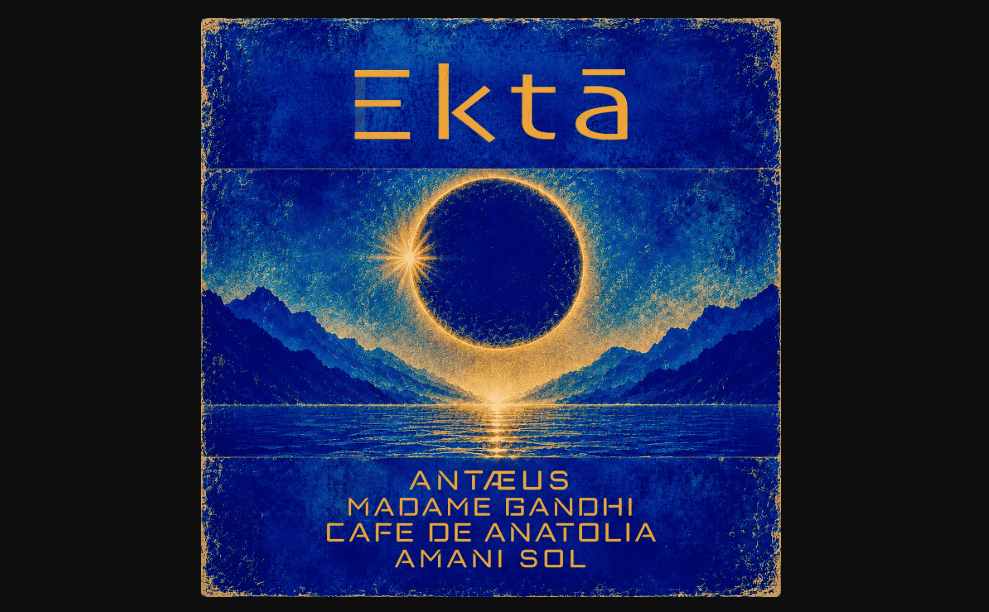
Antaeus, Madame Gandhi, Cafe De Anatolia and Amani Sol bring together an international ensemble of electronic and acoustic musicians for a deeply immersive album shaped by spirituality, mindfulness and the idea of unity.
On August 14, 2026, Cafe De Anatolia released Ektā, an expansive collaborative album that explores the meeting point between electronic music, traditional instrumentation and contemplative sound.
Bringing together Antaeus, Madame Gandhi, Cafe De Anatolia and Amani Sol, the project deliberately resists conventional genre definitions. Ambient textures, downtempo production and new-age influences intersect with Indian, Balkan, Middle Eastern and other global musical traditions, resulting in a record that feels less like a conventional electronic album and more like an extended sonic journey.
At the center of Ektā is its title. Meaning “oneness,” Ektā provides the conceptual framework for the entire project. The album approaches music as a universal language, using collaboration to connect different cultures, instruments and artistic perspectives within a single cohesive work.
Rather than being constructed around traditional club structures or conventional pop songwriting, Ektā prioritizes atmosphere, texture and emotional resonance. Its compositions unfold gradually, allowing acoustic instruments, vocals and electronic elements to occupy their own space while contributing to a larger sonic narrative.
An International Ensemble Behind the Album
The scale of the collaboration is one of the defining characteristics of Ektā.
Production comes from Antaeus, Nickarth, Billy Esteban and Amman Ahmed, while the vocal contributions include Madame Gandhi, AleMor and East Balkan Noble Voices.
The album’s instrumental credits reveal an equally diverse musical palette.
Billy Esteban contributes tamboura and guitars, while Antaeus and Amani Sol provide keyboards. Violin performances come from Frederika Krier and An Vedi, adding an organic melodic dimension to the electronic framework.
Traditional instrumentation plays a particularly important role throughout the project. The Iasi Ensemble contributes sitar and esraj, while Pete Giatrakos performs dulcimer and Thanassis Vassilopoulos contributes nay. The sound of the oud and duduk comes from Rialians On Earth, further expanding the album’s connection to Middle Eastern and Mediterranean musical traditions.
The final recordings were shaped by engineers Joe Maldonado, Tony Correlli and Alex Psaroudakis.
Taken together, these contributions create an unusually broad sonic vocabulary — one in which electronic production does not replace traditional instrumentation, but instead provides a contemporary environment for it to exist.
Beyond Genre: New Age, Ambient and Downtempo
The musical identity of Ektā is intentionally fluid.
The album moves through new age, ambient, downtempo and organic electronic music, while incorporating elements of world music and traditional vocal performance.
That fluidity is central to the project’s appeal. Rather than attempting to define itself through a single genre, Ektā reflects the increasingly blurred boundaries of contemporary electronic music, where producers and artists are exploring sound as an immersive experience rather than simply a vehicle for dancefloor energy.
The production emphasizes space and detail. Electronic textures sit beneath acoustic instruments, while vocals are integrated into the compositions as both melodic and atmospheric elements.
The result is music designed to reward focused listening.
It can function as a meditative soundtrack, a late-night listening experience or an introduction to the more contemplative side of electronic music.
“Goddess Mantra” and the Dialogue Between Tradition and Modernity
Among the album’s standout compositions is “Goddess Mantra,” a track that exemplifies the project’s approach to cultural fusion.
The composition combines Madame Gandhi’s vocals with sitar performed by the Iasi Ensemble, incorporating an Indian-inspired rhythmic structure based around a 3/4 interpretation of taal.
What makes the track particularly significant is the way its traditional influences are integrated into contemporary production. Rather than presenting the sitar or rhythmic elements as isolated samples, the instrumentation becomes part of the composition’s core architecture.
The result is a hypnotic piece that demonstrates how traditional musical systems can coexist naturally with modern electronic production.
It is also representative of Ektā as a whole: rooted in musical heritage while remaining firmly contemporary.
“Desert Night” Brings the Album Full Circle
The closing track, “Desert Night,” features East Balkan Noble Voices and An Vedi, providing a fitting final chapter to the album’s cross-cultural journey.
The inclusion of East Balkan vocal traditions introduces another distinct cultural dimension to the project, while An Vedi’s violin adds an additional layer of organic instrumentation.
Placed at the conclusion of the album, “Desert Night” reinforces the project’s central philosophy. The record begins with individual musical traditions and gradually brings them into dialogue, ultimately arriving at a space where those distinctions coexist within a unified sonic environment.
It is a fitting conclusion to an album whose central concept is connection.
Cafe De Anatolia Expands Its Artistic Vocabulary
For Cafe De Anatolia, Ektā represents a natural but significant expansion of its established artistic language.
The collective has become internationally associated with electronic music that incorporates organic instrumentation, global influences and cinematic atmospheres. Its catalog has consistently explored the relationship between contemporary electronic production and musical traditions from different parts of the world.
Ektā takes that philosophy beyond the dancefloor.
Here, the objective is not simply to create an Organic House or downtempo record, but to investigate what happens when electronic music becomes a framework for cultural dialogue and introspection.
The album therefore occupies an interesting position within the current electronic landscape. As audiences increasingly embrace ambient music, wellness-oriented listening and slower forms of club culture, projects such as Ektā demonstrate how electronic music can evolve without abandoning its connection to rhythm and technology.
A Collective Approach to Creativity
Another defining characteristic of Ektā is that its identity does not belong to a single artist.
The project is deliberately collective.
Antaeus, Madame Gandhi, Cafe De Anatolia and Amani Sol provide the central creative framework, while the extended ensemble contributes instruments, voices and production expertise from different musical backgrounds.
That approach mirrors the meaning behind the album’s title.
The project is built around the idea that individual artistic identities can remain distinct while becoming part of something larger.
The sitar does not have to sound less traditional to coexist with electronic production. Balkan vocals do not need to be separated from contemporary instrumentation. Electronic music does not have to abandon its technological foundation to become organic.
Instead, Ektā proposes that these elements can exist simultaneously.
A Record About Connection
In the end, Ektā is less concerned with defining what electronic music should sound like than with exploring what it can become.
Its combination of electronic production, traditional instruments, global vocal traditions and contemplative songwriting creates a record that reflects the increasingly international nature of contemporary music.
The album’s philosophy is straightforward: different sounds can become one composition, just as different cultures can meet through music.
That idea gives Ektā its strongest sense of identity.
Released on August 14, 2026, the album arrives as an ambitious statement from Cafe De Anatolia and its collaborators — a project that places mindfulness, spirituality and cultural exchange at the center of a contemporary electronic production.
For listeners familiar with Cafe De Anatolia’s Organic House legacy, Ektā offers a different perspective on the collective’s musical universe. For those discovering the project for the first time, it provides an expansive introduction to a sound that exists somewhere between electronic music, world instrumentation and meditation.
Ultimately, Ektā is a record about finding common ground.
Not through a single genre, a single culture or a single musical tradition, but through the idea that sound itself can become a language of oneness.
Ektā — Full Creative Credits
Producers: Antaeus, Nickarth, Billy Esteban, Amman Ahmed
Vocals: Madame Gandhi, AleMor, East Balkan Noble Voices
Tamboura / Guitars: Billy Esteban
Keyboards: Antaeus, Amani Sol
Violin: Frederika Krier, An Vedi
Percussion: Madame Gandhi
Sitar / Esraj: Iasi Ensemble
Dulcimer: Pete Giatrakos
Nay: Thanassis Vassilopoulos
Oud / Duduk: Rialians On Earth
Engineers: Joe Maldonado, Tony Correlli, Alex Psaroudakis
Released August 14, 2026 — Ektā is available across major streaming platforms.