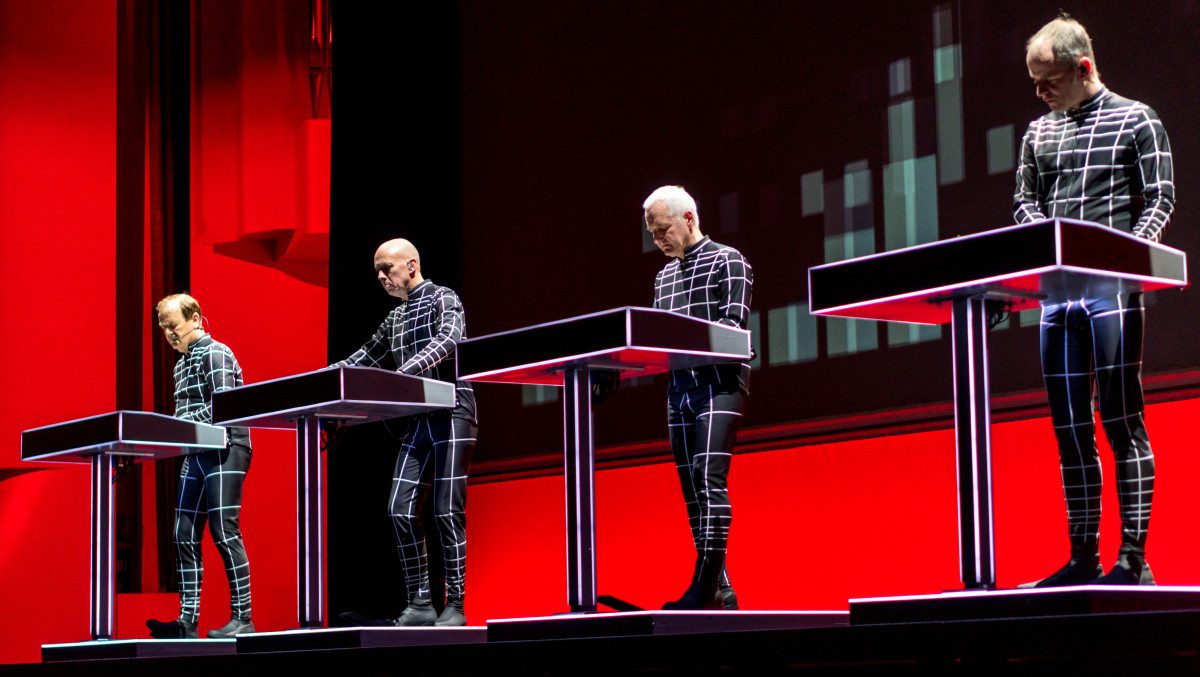
After almost three decades of legal proceedings, one of electronic music’s most consequential sampling disputes has reached another landmark decision.
Germany’s Federal Court of Justice has ruled against pioneering electronic group Kraftwerk, determining that a two-second fragment taken from the band’s music and reused by producer Moses Pelham qualifies for protection under the legal concept of “pastiche.”
The decision could have significant implications for producers and artists working with samples across Europe, offering greater clarity around when existing recordings can be creatively reused without obtaining permission.
A Two-Second Sample That Became a 27-Year Legal Battle
The dispute dates back to 1999 and centers on Kraftwerk’s 1977 track ‘Metall auf Metall’, featured on the group’s landmark album Trans-Europe Express.
The song contains metallic percussion designed to evoke the sound and rhythm of a moving train. Pelham extracted an approximately two-second rhythmic passage from the recording, slowed it slightly and looped it throughout ‘Nur Mir’, a track performed by German rapper Sabrina Setlur.
What followed was one of the longest-running copyright disputes in European music.
Kraftwerk argued that the unauthorized use of its recording infringed upon the group’s rights, while Pelham maintained that the sample formed part of a creative musical reinterpretation.
The case subsequently moved through multiple levels of Germany’s legal system, eventually reaching the European Court of Justice (ECJ).
European Court Ruling Changed the Sampling Debate
A major turning point came in 2023, when Germany’s Federal Court of Justice sought guidance from the European Court of Justice on how European copyright law should treat sampling.
The ECJ determined that sampling can be permissible when the new work uses an existing recording in a way that imitates, pays tribute to or engages creatively with the original.
Germany’s highest civil court has now applied that interpretation to the Kraftwerk-Pelham dispute.
According to the ruling, transferring the sampled electronic element into a different musical genre gave it a creative function within the new composition, allowing it to fall under the “pastiche” exception.
The distinction is important. The ruling does not mean that musicians are now free to take copyrighted recordings without restrictions.
Instead, it establishes a clearer framework for determining when sampling can be considered a legitimate form of artistic dialogue rather than straightforward unauthorized reproduction.
What the Kraftwerk Ruling Means for Music Producers
For electronic music producers, hip-hop artists and other sample-based musicians, the decision could prove particularly significant.
Sampling has always existed in a complicated space between technological creativity and copyright law. A tiny fragment of a recording can become the foundation of an entirely new composition, but obtaining clearance can sometimes be expensive, complicated or impossible.
The court’s interpretation of “pastiche” provides producers with greater legal certainty while preserving boundaries around copyrighted material.
Pelham’s legal team argued that sampling is itself an established creative technique and that artists do not necessarily need to demonstrate a specific intention for a work to qualify as pastiche.
Instead, the character of the creative engagement can be recognizable to listeners familiar with the original.
That interpretation could become particularly relevant as producers continue to explore increasingly sophisticated forms of sampling, remixing and musical quotation.
Kraftwerk Still Questions Where the Line Should Be Drawn
For Kraftwerk, however, the ruling leaves an important philosophical and legal question unresolved.
The group’s frontman Ralf Hütter has continued to challenge the idea that unauthorized sampling should automatically receive protection simply because the borrowed material has been incorporated into a different artistic context.
Hütter’s legal representatives questioned where the boundary exists between genuine artistic dialogue and the unauthorized appropriation of another artist’s creative work.
That question remains at the heart of the sampling debate.
How much transformation is enough? When does a recognizable sample become a new creative statement, and when is it simply a shortcut around licensing and compensation?
The latest ruling provides guidance, but it does not eliminate those questions.
A Landmark Moment for Sampling Culture
The Kraftwerk case is significant precisely because the original sample was so short.
Two seconds of music ultimately generated nearly 30 years of litigation, demonstrating just how complicated the relationship between copyright and modern music production can become.
Kraftwerk’s influence on electronic music is difficult to overstate, and the dispute also carries an intriguing historical dimension: one of the artists who helped establish the foundations of electronic music culture became central to a legal battle over how future generations could manipulate recorded sound.
The latest decision therefore extends far beyond one track or one producer.
For musicians across Europe, the ruling may provide a stronger legal foundation for creative sampling. But it also reinforces the need to understand the difference between inspiration, transformation and reproduction.
Importantly, Kraftwerk’s counsel has noted that Pelham remains liable for damages awarded in earlier German proceedings, meaning the latest decision does not simply erase the financial consequences of the previous rulings.
After nearly three decades, the case may have finally provided an answer to one question — while leaving the broader debate over who owns a fragment of recorded sound very much alive.